
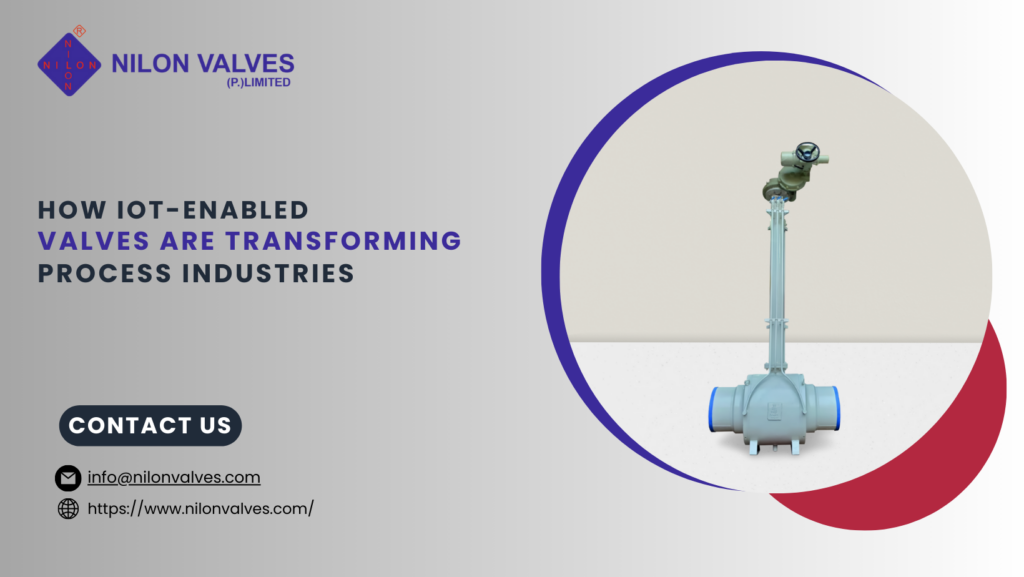
The process industry is undergoing a massive digital transformation. From oil & gas and power plants to water treatment and chemical processing, companies are under constant pressure to improve efficiency, reduce downtime, enhance safety, and meet stricter regulatory standards. At the heart of this transformation lies a powerful combination of Industrial Internet of Things (IIoT) and advanced valve technology.
IoT-enabled valves are no longer a futuristic concept—they are rapidly becoming a critical component of smart, connected industrial systems. By integrating sensors, connectivity, and data analytics, these valves are redefining how flow control systems are monitored, operated, and maintained.
Understanding IoT-Enabled Valves
IoT-enabled valves are traditional industrial valves enhanced with smart sensors, communication modules, and software intelligence. These components allow valves to collect real-time data such as:
- Pressure
- Temperature
- Flow rate
- Valve position
- Vibration and wear indicators
This data is transmitted to centralized systems through industrial communication protocols or cloud platforms, enabling operators to monitor and control valve performance remotely.
The Shift from Reactive to Predictive Operations
One of the most significant transformations brought by IoT-enabled valves is the shift from reactive maintenance to predictive maintenance.
Traditional Approach
In conventional systems:
- Valves are inspected manually
- Maintenance is scheduled at fixed intervals
- Failures are often detected after performance drops or breakdowns occur
This approach leads to:
- Unexpected downtime
- Higher repair costs
- Safety risks
IoT-Driven Predictive Maintenance
Smart valves continuously monitor operating conditions and detect early warning signs such as abnormal pressure fluctuations or actuator strain. This allows operators to:
- Predict failures before they occur
- Schedule maintenance only when needed
- Extend valve life cycles
The result is reduced downtime, lower maintenance costs, and improved asset reliability.
Real-Time Monitoring and Remote Control
IoT-enabled valves provide real-time operational data that can be accessed from control rooms, mobile devices, or centralized dashboards.
Benefits of Real-Time Visibility
- Immediate detection of leaks or flow irregularities
- Faster response to process deviations
- Improved decision-making based on live data
In large industrial plants or geographically dispersed facilities such as pipelines or water distribution networks, remote monitoring eliminates the need for frequent site visits, saving both time and operational expenses.
Enhanced Process Efficiency and Optimization
Process industries rely heavily on precise flow control. Even minor inefficiencies can lead to product loss, energy waste, or quality issues.
IoT-enabled valves contribute to process optimization by:
- Automatically adjusting valve positions based on real-time demand
- Integrating with Distributed Control Systems (DCS) and SCADA platforms
- Enabling data-driven process fine-tuning
Integration with Industry 4.0 Ecosystems
IoT-enabled valves are a key enabler of Industry 4.0, where interconnected machines, intelligent systems, and advanced analytics drive smarter manufacturing.
Seamless Connectivity
Smart valves can integrate with:
- Manufacturing Execution Systems (MES)
- Enterprise Resource Planning (ERP) platforms
- Cloud-based analytics tools
The Future of IoT-Enabled Valves
Looking ahead, IoT-enabled valves will become even more intelligent with the integration of:
- Artificial Intelligence (AI) for advanced diagnostics
- Machine learning for adaptive control
- Digital twins for simulation and performance prediction
As industries continue to prioritize automation, sustainability, and efficiency, smart valves will be a foundational element of next-generation process plants.
Also Read: Why India Is Emerging as a Global Hub for Butterfly Valve Manufacturing
Conclusion
IoT-enabled valves are transforming process industries by delivering real-time insights, predictive maintenance, enhanced safety, and optimized performance. They represent a shift from traditional, manual operations to connected, intelligent, and data-driven flow control systems.